Who to contact (fast)
Call 911
Serious injuries, immediate danger, suspected impaired driving, or you need emergency response.
Check 511 Alberta
Road conditions, closures, and current alerts before or during a trip (web + “Dial 5-1-1” in Alberta).
Report a collision
Use Alberta’s official collision reporting guidance (including the online Report My Collision service where eligible).
Emergency kit (what Alberta recommends)
Alberta Transportation encourages keeping a vehicle emergency kit—especially in winter—so you can stay safe if you’re delayed, stuck, or waiting for help.
Core items (vehicle emergency kit)
- First aid kit
- Fire extinguisher
- Blanket
- Road map and compass
- Extra clothing and footwear
- Paper towel or rags
- Sand, road salt, or non-clumping kitty litter (traction)
- Flashlight + extra batteries
- Emergency food (non-spoiling)
- Ice scraper and snowbrush
- Cell phone (and ideally a charger)
- Candle in a deep tin + waterproof matches
- Shovel
- Booster cables
Tip: keep your fuel tank more than half full in winter so you’re better prepared if you become stranded.
Vehicle breakdown (safe step-by-step)
- Signal early and pull over as far off the road as you safely can (shoulder, turnout, parking lot).
- Hazard lights on. If visibility is poor, be extra cautious when exiting.
- Stay safe first:
- If you’re on a high-speed road or it’s dark/windy/snowing, prioritize staying safe over fixing the car.
- If you exit, avoid standing between vehicles or near traffic lanes.
- Make the scene visible (only if safe): place warning triangles/flares well behind your vehicle.
- Get help: roadside assistance/tow, and use 511 Alberta to understand closures or hazards if you’re travelling.
Collision: what to do (Alberta rules + practical checklist)
Alberta’s official guidance focuses on safety, documentation, and reporting. Use this checklist as your “at-the-scene” flow.
1) Stop + stay calm
- Do not admit fault or agree to “settle on the spot.”
- Turn on hazard lights.
2) Call 911 if needed
- Call 911 if anyone is seriously injured or you suspect a Criminal Code offence (for example, impaired driving).
3) Make the scene safer
- Do not move injured people.
- Do not stand between vehicles or behind a vehicle to inspect damage.
- If your vehicle is drivable and it’s safe (and there are no serious injuries), move it out of traffic to the side of the road.
- If your vehicle is not drivable, use hazard lights and (if safe) warning triangles/flares, and move to a safer spot away from traffic.
4) Report to police when required
- Report to police if anyone is injured, if a driver lacks required documents, or if a vehicle isn’t drivable.
- If combined damage is $5,000 or more, Alberta’s guidance says you must file a collision report with police (and keep the file number).
- If public property is damaged (traffic devices/signals, etc.), you must report it to police even if damage is under $5,000.
5) Exchange info + document
- Exchange contact + insurance information with other parties.
- Take photos (damage, plates, location, road conditions) if it’s safe.
Online option: Report My Collision (where eligible)
Alberta’s Report My Collision service supports reporting certain collisions online (in selected areas) and can issue a digital damage sticker after law enforcement review.
- Requires an Alberta driver’s licence + Alberta.ca account.
- Only for specific collision types and no injuries/fatalities.
- Uses a $5,000 damage threshold and includes photo uploads and collision details.
Important repair note (Alberta)
Alberta’s guidance also notes auto body shops are prohibited from making collision-related repairs of more than $5,000 without a damage sticker (as of Jan 1, 2024).
Emergency vehicles + roadside workers
When an emergency vehicle approaches (lights/siren)
- Pull over parallel to the road (typically to the right) and stop until it passes.
- Don’t stop in the middle of an intersection—clear it if you can safely do so.
- Do not drive within 150 metres of an emergency vehicle with its siren and/or flashing lights on.
When you see flashing lights on the roadside (tow trucks, police, maintenance, construction)
- Move over to the far lane if you’re in the closest lane and it’s safe to do so.
- If you can’t safely move over, slow down to 60 km/h or the posted speed (whichever is lower).
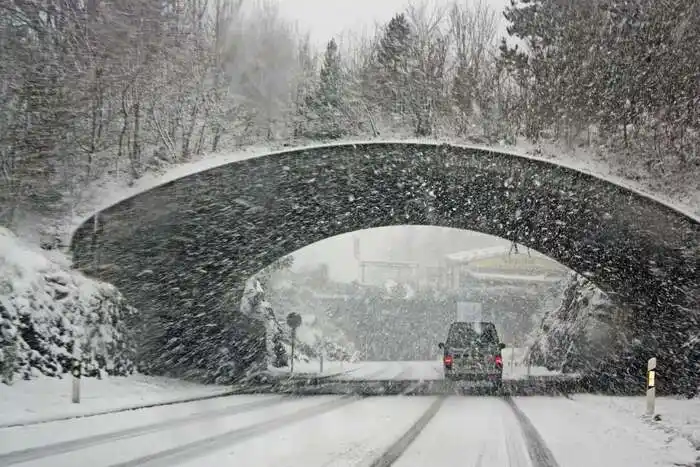
Winter storms, whiteouts, and getting stranded
Before you go
- Avoid travel during major storms when possible.
- Check road conditions and alerts on 511 Alberta.
- Ensure you have a well-stocked vehicle emergency kit.
If you start to skid (winter driving tip)
- Take your foot off the brake and steer in the direction you want to go.
- When you regain grip, brake firmly and smoothly.
- Avoid sudden steering or braking inputs that can cause a spin.
If you are stuck in your vehicle
- Remain calm, stay inside, and call for help.
- Run the engine occasionally for warmth, but watch for exhaust fumes and ensure the exhaust pipe is not blocked with snow.
- Let fresh air in by opening a window slightly on the sheltered side (away from wind).
Heavy rain + hydroplaning (wet roads)
If you think you’re hydroplaning
- Reduce speed smoothly.
- Do not brake or turn suddenly.
- Keep tires properly inflated to reduce hydroplaning risk.
If visibility drops (fog/heavy mist)
- Use low beams (high beams can reflect moisture back into your eyes).
- If you can’t see, pull as far off the road as you safely can and use hazard lights.
Mechanical emergencies while moving
These are “keep control first” situations. Your goal is to slow down safely and get to a safe stop.
Brake failure
- Shift down to a lower gear (even in an automatic) so the vehicle begins to slow.
- Apply the park brake and bring the vehicle to a safe stop.
- Do not drive again until brakes are checked/repaired.
- If power assist is lost (engine stalls), push harder—brakes still work, but require more force.
Tire failure / blowout
- Grip the steering wheel firmly and hold a straight course.
- Do not touch the brakes at first.
- Ease off the gas and let the vehicle slow.
- Once slowing, brake gently and steadily, then pull off the road completely if possible.
- Turn on four-way hazard lights.
If your wheels drop off the pavement edge
- Grip the wheel firmly and resist jerking back onto the road.
- Ease off the gas, slow down, shoulder check, then return gradually once control is steady.
References (Alberta government websites only)
https://www.alberta.ca/automobile-collisions-insurance
Collision reports + online service eligibility (Report My Collision):
https://www.alberta.ca/collision-reports
https://www.alberta.ca/system/files/tec-rmc-fact-sheet-albertan-support-05-2025.pdf
Emergency vehicles (pull over + 150 m rule):
https://www.alberta.ca/reacting-to-emergency-vehicles
Roadside worker safety (move over / slow to 60 km/h or posted speed):
https://www.alberta.ca/roadside-worker-safety
Winter driving + emergency kit list:
https://www.alberta.ca/safer-winter-highways
https://www.alberta.ca/system/files/custom_downloaded_images/tr-swh-driving-tips.pdf
Storm safety + stuck-in-vehicle guidance:
https://www.alberta.ca/blizzards-freezing-rain-ice-storms-and-extreme-cold
511 Alberta (road conditions, closures, alerts):
https://511.alberta.ca/
Mechanical emergencies guidance used on this page (Alberta Transportation PDF):
https://www.transportation.alberta.ca/Content/docType45/Production/gearedtogoapril2008.pdf
Wet weather + hydroplaning guidance (Government of Alberta release PDF):
https://www.alberta.ca/release.cfm?xID=198521F270156-EBA4-D325-3C5D72132952AF91